Glasgow Global Street Paper Summit 2026
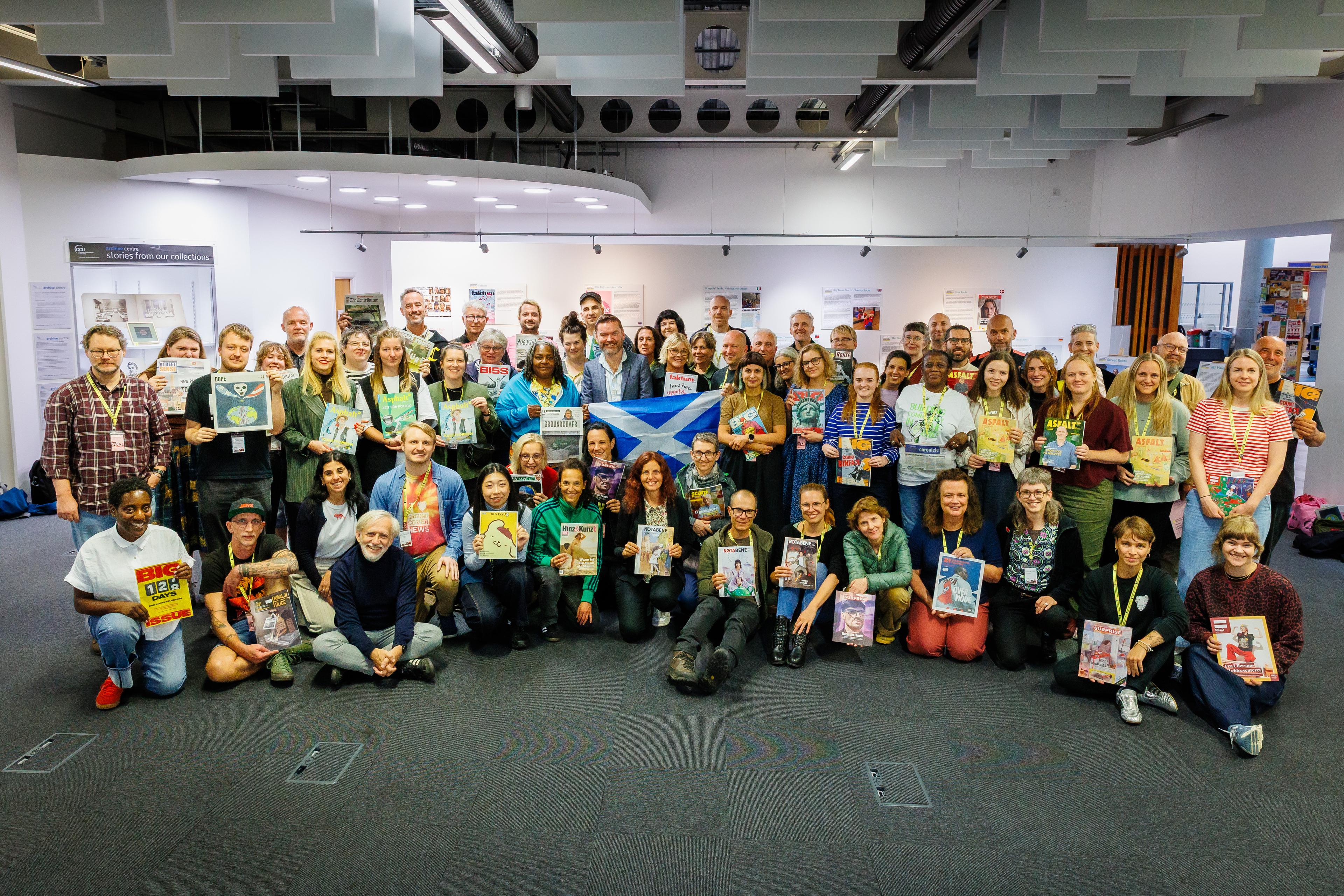

Photo by Jack Donaghy
By Brontë Schiltz
- Street paper news
From Monday 31 August to Thursday 3 September, delegates from over 30 street papers in 18 countries gathered in Glasgow, Scotland for the 2026 International Network of Street Papers Summit.
Monday
The opening evening broke with formal convention for a relaxed gathering at Civic House – a social enterprise creative hub built in the 1920s as Civic Press. Attendees enjoyed complimentary food provided by Social Bite, a local non-profit dedicated to designing and delivering systemic interventions to end homelessness, alongside a warm welcome to the city from a line-up of local Glaswegians who support INSP.
Tuesday
We stand at a crucial time in the future of the street paper movement. To open the formal programme, a group of members considered fundamental questions: What is INSP’s core activity? What is a sustainable model for the future? And how can INSP best serve members’ interests?
Attendees then joined Professor John McKendrick from Glasgow Caledonian University as he gave an overview of poverty in Scotland and what is being done to tackle it. This keynote involved input from participants and reflections on what lessons can be learned from Scotland.
The Big Issue Australia explained how they introduced fundraising as a new and growing income stream, with a particular focus on its investment in face-to-face fundraising, from a marketing, communications and fundraising perspective.
Another session explored what it means to adopt a trauma-informed approach across different areas of our work, from journalism to working with vendors, to strengthen social impact, improve outcomes for vendors, and help organisations create more compassionate and effective practices.
Street papers have a twin role – reporting on the issues that matter and supporting marginalised people to earn an income and change their lives. We explored how those roles can join together to create real opportunities in journalism.
We also looked at the big challenges that street paper organisations face, and what models we use as leaders to help us to achieve our goals, including Theory of Change and leading across cultures.
Members from BISS then gave an insight into how they believe street papers can learn to think differently, break down barriers and shake off some of the myths and misconceptions that are holding us back in our fight for social justice.
Finally, media and mental health expert Hannah Storm examined how we hold onto a sense of purpose and remain hopeful in tough times. She shared some of her own story and offered tips and tools for dealing with some of the emotionally heavier work, providing a space to consider how we can support ourselves better.
Wednesday
As authoritarian governments are elected around the world, the role of the journalist becomes more vital – and more challenging – than ever. A panel of street papers from Serbia, Hungary and the US, plus insight from Azerbaijan’s only independent media outlet, explored the landscape for the media under these regimes.
A session on creating solutions to declining sales, run by Surprise, co-created a global collection of ideas, questions, experiments and approaches that organisations can draw on or find inspiration from when developing solutions to declining paper street sales that fit their own specific contexts.
Augustin provided insights into their cashless tool, set for launch in October 2026 to offer the option to purchase an online edition of Augustin alongside the print version. Since this is open-source software, it can be adapted by any street paper.
Annemarie Cuccia, from Street Sense Media, and PhD candidate Sayuri Kusama, formerly of The Big Issue Japan, whose research examines how language has been used to represent homelessness in the British press, then explained the best practice behind developing media guidelines to report on homelessness.
Jo Heim from HEMPELS and Alan Smith, who works for UK prison libraries, explored how to engage with people with experience of the criminal justice system, including discussion of creative workshops and a HEMPELS special issue.
This was followed by the Unconference, with topics including board structure, online sales, additional products, Vendor Week, employment models and tax law, supporting new and non-member street papers, revenue vs. circulation, the News Service, and vendor recruitment and demographics.
In the evening, delegates gathered at the National Piping Centre for a three-course meal, free whisky tasting and a performance by local band The Tenementals.
Thursday
Our final day opened with our Annual General Meeting (AGM), with reflections from board members Sarah Britz (Chair; Faktum), Nikoleta Kosovac (Vice Chair; Liceulice), Viggo Mastad (Treasurer; =Oslo) and George Wright (Big Issue North).
Adele Zeynep Walton then led a discussion on the role of Big Tech in shaping the news, and why independent journalism is so important. Alongside a panel of members from Faktum, Rohee and Mi Valedor, she explored how street papers can find a balance and play a role in the fight for a human-centric future.
This was followed by a panel on innovations, featuring Scarp de’ tenis on creating a podcast, Kralji Ulice on providing addiction recovery support, Big Issue North on producing additional products and =Oslo on organising anniversary celebrations.
Local INSP supporter, and cultural intelligence expert and author, Lucy Butters then joined delegates for a final session in which participants were invited to reflect on their learnings from the week, as well as to make commitments individually and collectively towards the street paper movement.
For the grande finale, we returned to the Social Hub hotel to celebrate this year’s INSP Awards, followed by a performance by the Lodging House Mission (LHM) 360 Choir to sing out the final moments of our 2026 Summit.
Reflections
“Across our countries, realities differ but challenges are familiar: poverty, homelessness, rising living costs, war, displacement and growing inequality,” said Sarah Britz, Chair of the INSP Board. “At the same time, independent journalism is under increasing pressure, threatening the voices and stories that need to be heard. And we know who is hit first – and hardest – when societies become less secure.
“Our work matters. But our organisations also face difficult questions. How can we remain strong when resources are increasingly stretched? The answers matter to thousands of people who rely on the opportunities that street papers create.
“That is why this summit matters. We listen, challenge each other, share, learn, laugh, argue and think. Then we go home – to our vendors and everyday challenges. Hopefully with new knowledge, energy and one important reminder: none of us are alone.”
“In almost all the countries from which delegates came, the current crises are tangible,” said Bastian Pütter from bodo. “Many feel the effects of political, social, and economic crises directly in their work: as a threat to press freedom, in government crackdowns on the poor and homeless, in a growing lack of solidarity, and in financial pressure.
“Nevertheless, at no point did I get the feeling that this was a swan song. Many young colleagues have joined us, and many projects are showing great resilience, adapting to a situation marked by scarce resources and external threats, and looking ahead.
“Returning home with renewed courage, confidence, and energy – combined with the knowledge that we are not alone in this unique intersection of journalism and homelessness advocacy – is the greatest success a summit can achieve. In my view, the days in Glasgow accomplished just that.”
“The conference hit all the right notes. I think we have created momentum for the street paper movement,” said Suzanne Hanney from StreetWise. “All in all – a success!”
You can watch the Summit video summary here.
You may also be interested in...

Q&A: How The Big Issue Australia is empowering women through enterprise
Read more

Street Sense Media vendors stage play exploring solutions to homelessness
Read more