True Criminology: “Whose sense of safety are we actually talking about?”
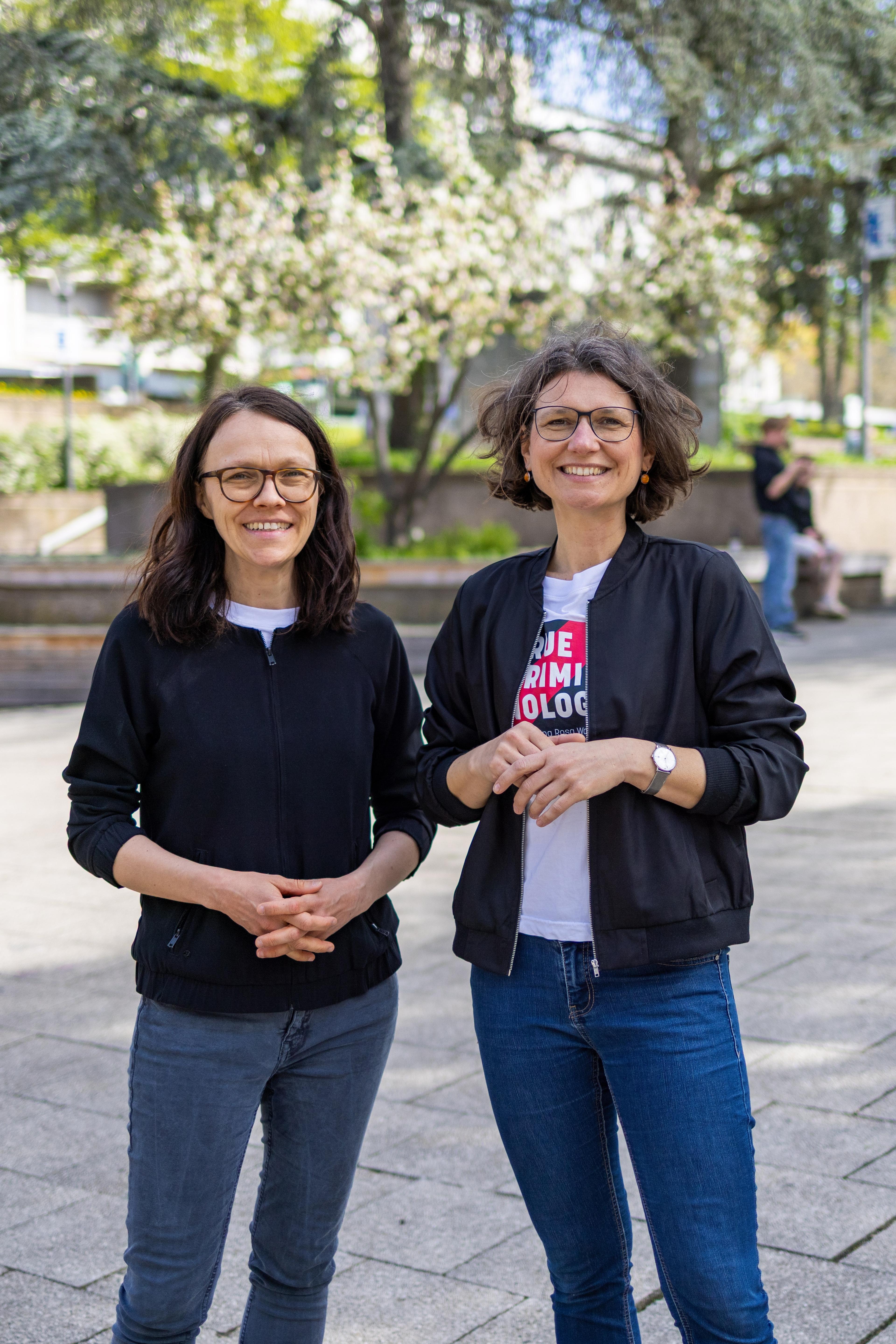

Photo by Gregor Nick
By Helmut Nick & Gregor Nick
- Opinion


DRAUSSENSEITER: How did you come up with the idea of starting a podcast on criminology?
Nicole Bögelein: We are both criminologists. We are sociologists by training but have been conducting research in the field of criminology for many years. We found that we were often approached by the media, but the questions were always very narrowly focused on a particular topic and never really captured the full picture. You only get about three sentences for a soundbite. But that isn’t enough to explain the issue properly. So we started thinking about how we could make the knowledge that’s already out there more accessible to a wider audience. This knowledge can be found in research papers but unfortunately often remains within the academic community. So we thought: we need to start a podcast.
Street crime probably has a major influence on how safe people feel. How has it changed over the past 10 years?
Gina Wollinger: Street crime covers all crime that takes place in public spaces. If we look at the past 10 years, we can see that street crime has declined. There was a slight increase after the pandemic. But now we are seeing a decline again – overall, we have had less street crime over the longer term.
What makes the idea of law and order – or, as people used to say, “discipline and order” – so appealing?
Bögelein: Law is an area where political decisions can be made “easily”: a tool available to policymakers is the ability to pass laws. Penalties can be written into laws. At a political level, laws and penalties can be used to demonstrate a willingness to bring about change. But the fact that this does not actually bring about much change is usually less important; the main aim is to send a message: “We are strong, we can assert ourselves.”
How are crime and poverty connected?
Bögelein: At first glance, you might think that poverty causes crime. After all, people in prison are poorer than average. They are also in worse health. People who appear in court are poorer too. So it may seem logical that poverty leads to crime.
But you can also look at it the other way round and find that people living in poverty are subject to greater criminalisation. They are more likely to be in public places and are therefore more likely to be stopped and checked. The offences they commit come more readily to the attention of the police – for example, shoplifting and fare evasion.
Another question that often goes unasked is: how are wealth and crime connected? This is an area that has received relatively little attention. We pay less attention to economic crime, corporate crime and tax evasion. It is certainly worth asking how crime relates to wealth or income.
The issue of whether people living in poverty end up in prison is also tied to how people without money are able to navigate the justice system. They are disadvantaged in many ways. This means that they are less able to afford a lawyer.
There is one area where the link between poverty and criminalisation is particularly clear: when people are imprisoned because they cannot pay a fine. In this case, poverty really does lead to imprisonment. When people are fined – often for poverty-related offences – they are frequently unable to pay and are therefore imprisoned. This means that the condition for imprisonment is the inability to pay the fine – in other words, being poor. Looking at the people imprisoned for being unable to pay a fine, we can see that over one fifth had previously been homeless or at least had no fixed address. A large proportion struggle with addiction, while mental illness, suicidal thoughts and debt are also present. So this is far removed from what one would generally consider a normal, everyday life. The employment rate is also very low. So we can see that when dealing with the state, people are affected differently depending on whether they have money or not.
Does punishment act as a deterrent?
Wollinger: It is generally accepted in criminology that what acts as a deterrent is not the punishment itself but rather the risk of being caught. It is more a question of whether I will get caught if I do something than how severe the punishment might be. We can also see this clearly from the fact that people often have no idea what level of punishment they might face. People do not read the criminal code before deciding which offence to commit; the circumstances and motives that lead to crime are entirely different. Changing the level of punishment in an attempt to reduce crime is ineffective and often more about sending a political message.
Your book, True Criminology, states that the reasons people commit crimes have nothing to do with their migration status. Can you elaborate on that?
Wollinger: The question “Are migration and crime connected?” has to be answered with both “yes” and “no”. On the one hand, we do see some notable patterns, as non-German suspects are “overrepresented” in police crime statistics – in other words, they make up a larger proportion of suspects than non-Germans do of the population. But non-German or immigrant groups are often not representative cross-sections of the societies they come from; rather, they often consist of young men.
Being young and being male are, in and of themselves, two factors that are more strongly associated with crime. Studies that capture unreported crime, for example studies on youth violence, show that when all the factors that explain violence are taken into account, migration is no longer part of the equation. Rather, it is the risk factors themselves that are sometimes more common among people who have immigrated or have a migration background.
It is always important to point out that only a very small proportion of people with a migration background or without a German passport commit crimes. This is often overstated in public debate when discussing risk factors that may be more common in certain immigrant groups: it still only concerns a very small proportion! Since 2007, for example, we have seen prolonged periods of immigration alongside a sustained decline in violent crime.
Our observation is that media coverage often blows this out of proportion.
Bögelein: There is a long-term study on this by Hamburg-based researcher Professor Thomas Hestermann, titled “Wie häufig nennen Medien die Herkunft von Tatverdächtigen?” (“How often do the media mention the background of suspects?”). He examined media coverage over many years and analysed the extent to which nationality is mentioned in media reports on violent crime. And in fact, offences involving non-Germans receive more media coverage. In his conclusion, he writes: “Media coverage has not become clearer but more distorted... While the background of suspects played virtually no role in 2014, it was mentioned in one in six articles in 2017 and in one in three articles in 2019.” The topic is not treated as a taboo, as is often claimed; rather, media coverage has been distorted and sensationalised for decades, and this has been the subject of criminological research.
Especially in cities such as Cologne, we often hear people say, “I don't feel safe in certain places anymore.”
Wollinger: Yes, we hear that a lot. A person’s sense of safety must always be distinguished from actual crime levels, as the two do not necessarily develop in the same way. When a person thinks about safety, they primarily think about public spaces. They think about how great the risk is of being attacked out of nowhere when they are outside. This risk is very low in Germany! People generally feel safe in their own neighbourhood. But in certain places, people feel less safe – for example, on public transport or near railway stations, especially in areas that are a little dirtier or more run-down, or in places where certain groups of people gather, such as people experiencing homelessness or those who openly use drugs. This makes many people feel uneasy, even though they do not actually face a greater risk of becoming victims of crime there.
People’s sense of safety varies greatly. The very people who make others feel unsafe – such as people experiencing homelessness or addiction – face a real risk of experiencing violence and crime themselves. This is often overlooked in current debates. Violence against people experiencing homelessness is particularly prevalent in public spaces, not only at the hands of other people experiencing homelessness, but also of those considered part of the so-called “normal” population. There are also recurring, particularly serious cases involving humiliation or physical assault. I think it’s important to ask whose sense of safety we are actually talking about!
The Cologne public transport operator (KVB) stopped reporting fare evasion to the police some time ago. At national level, fare evasion is still considered a criminal offence. Are there any findings on how Cologne’s approach has affected the number of journeys made without a valid ticket?
Bögelein: There are figures available on this. The KVB stopped reporting fare evasion to the police in the spring of 2024, and since then the number of passengers travelling without a ticket has not increased. It remains just under two percent. By the way, Federal Justice Minister Hubig has also suggested decriminalising fare evasion.
What can a city do to prevent crime or at least reduce it?
Wollinger: It depends on what type of crime we are talking about. Cooperation is particularly valuable at the local level. This means that institutions should not work in isolation but should communicate and coordinate with one another. One good example of what a city can do is to establish a crime prevention council as a permanent forum for this kind of exchange: where are the problems at the local level? Who is responsible for what? How can specific causes be tackled in practical terms?
If people from war zones are housed together in container settlements and prohibited from working, what behaviour can be expected?
Wollinger: This addresses the circumstances of immigrants with a refugee background. Their future prospects are crucial here. In criminology, we consider being connected to society an important factor. In other words, it means being integrated and having the opportunity to shape one’s own life. The numbers also reflect this. When many immigrants came to Germany in 2015 and 2016, special analyses showed that refugee groups with good prospects of being granted asylum became less likely to come to police attention. And it could also be said that situations where people have nothing to do and feel uncertain or are packed together in confined spaces are all things that can quickly lead to violence.
How do we become a better society?
Wollinger: A better society would be one where social peace prevails, or where this is pursued as a goal. This means low social inequality, broad opportunities for participation, the rule of law, and shared decision‑making. In our field, which concerns security and has sparked debates about the so‑called cityscape and public space, the aim must be to offer opportunities for participation to diverse groups. For example, young people – where can young people go if they live in cramped conditions? Anything that enables people to live self‑determined lives contributes to a better society.
Bögelein: From a criminological perspective, or from the perspective of our book: the minimum requirement is genuine equality within the criminal justice system. In our book, we argue for a feminist criminal justice policy — a criminal justice policy that takes the rights of all people seriously. We need a criminal justice policy that is critical of racism — one that also asks the questions: Where are people being disadvantaged? Where are they more frequently criminalised, more frequently subject to stop and search?
We need a policy that challenges classism, especially for people living on the streets. We know they are stopped and searched much more often. People have very different “chances”, in a negative sense, of coming into contact with the system of punishment and imprisonment. While a few people have been held criminally responsible for the Cum‑Ex tax fraud scandal, which caused billions of euros to be lost to the public purse — roughly a fifth of the federal budget — around 7,000 people are imprisoned each year for repeated fare evasion when they are unable to pay their fines.
Wollinger: If we look at criminal offences, much could be reformed, or rather decriminalised. In other cases, however, criminal prosecution must always be taken seriously. This is also connected to tackling social inequality. Viewed globally, we see that people tend to be happier and societies are more cohesive in countries with not such a high level of social inequality. The point is not that everyone should be rich, but that everyone should have roughly equal living conditions and be treated equally. When it comes to criminal law and criminalisation, we can see that much remains to be done to achieve this.
Well, at least the legislation on so‑called soft drugs has been somewhat reformed.
Bögelein: It’s precisely on the issue of drugs that you can clearly see the extent to which criminal justice policy can actually make a difference. After all, it’s a completely different approach if you pursue an accepting drug policy and say, “People are just addicted and we have to deal with it,” or if you continue to try to combat the issue repressively.
In Germany, a complete ban on illegal drugs was in place until the legalisation of cannabis. This means that there is no legal way to obtain any drugs other than cannabis. Consequently, people who come into contact with these drugs inevitably find themselves operating outside the law. We see that this leads to a downward spiral, simply because these people withdraw from their usual social circles and can no longer go about their daily lives “normally”.
In other countries, there is a shift away from the practice of criminalising drug users. In Germany, too, the view was that possessing a small amount for personal use was acceptable. But in reality, people often have slightly more than the amount for personal use, since they sometimes buy in advance or for others. In research, this is referred to as “social supply” — providing drugs to others without making a profit. But at that point, you’re already crossing into dealing — and that’s criminalised. As a result, what is commonly regarded as an illness is at the same time a criminal offence — something punishable by law. In Portugal, on the other hand, hard drugs have also been decriminalised. With this approach, law enforcement no longer targets users but focuses specifically on those handling larger quantities of drugs.
What is offender-victim mediation and does it exist in Germany?
Bögelein: It does. This is part of the so-called “restorative justice”. The English term “restorative justice” is often used. It brings together people who were involved with each other through an offence to talk. It’s always a prerequisite that both the victim and the offender are willing to take part. So it can’t happen without consent. It’s not just the two of you; there is always a mediator present. It’s an attempt to give the conflict back to the people involved, so that the offender has to confront the harm caused and realise the consequences of their actions.
Efforts are also made to help the victim understand the offender’s perspective: What exactly was going on for this offender? Why did it happen at that exact moment? Often there’s just a vague fear that “it could happen again at any moment”. Research shows that mediation is particularly effective in cases involving violent offences. Interestingly, it can also help in cases involving domestic violence. In fact, the evidence shows that it’s very beneficial for victims, especially in the case of violent crimes, to take part in restorative justice. Legally, this can be an alternative to criminal proceedings, but it does not have to be. It may also be conducted in parallel with criminal proceedings, subject always to judicial discretion.
Wollinger: It can be a mitigating factor; it can even take place post-conviction if the offender is in custody. The benefit is that it enables the victim to come to terms with the offence more effectively. It also impacts the offender, who must genuinely confront the consequences of their actions. That happens less often in prison or in court.
Do we have realistic perceptions of crime or are we labouring under certain misconceptions?
Wollinger: Our perception of crime is mainly shaped by the media. Thankfully, we don’t have so much crime that we or our neighbours experience it all the time; instead, our image of crime is shaped by the media. On the one hand, there is the news: Which offences are reported? How often are certain offences reported? On the other hand, it’s the entire entertainment format behind it: crime dramas and true-crime programmes that purport to depict real events. And even if no one actually says, “This case of knife crime we had yesterday is typical,” a generalisation still forms, together with an image that is highly unrealistic. There is a very strong distortion in how it is portrayed in the media. In other words, if we don’t question this critically, we completely overestimate the crime rate – particularly for offences such as murder and manslaughter.
Does a greater police presence help to prevent crime?
Bögelein: You could say that more police also “creates” more crime. Where there’s more police, there can be more stop‑and‑search. They can then record crimes that would otherwise have gone undetected. These offences would have taken place, but they would not have been recorded.
The point about police patrols is that they only help in specific situations. The patrol drives past a place for a minute, but then it’s no longer there. Paradoxically, it creates increased insecurity, as people think, “Oh, if there are so many police around here, it must be particularly dangerous here.” It’s very ambivalent.
A carpenter has nails and can hammer them into the wall with a hammer. And the job of the police is first and foremost to detect, fight and record crime. It makes a difference whether I send police or social workers to Ebertplatz, for example, because they have different approaches. If the police are on site and suspect that an offence has taken place, they must always record the facts and investigate. This is the so-called principle of legality that we have in Germany. Even if you call the police because someone seems confused or homeless, it can result in the police discovering during the identity check that there’s an arrest warrant outstanding – “aha, we’ll take them in!” Even if fewer incidents occur where there is a police presence, it doesn’t mean that the underlying motivation for offending goes away. Instead, a displacement effect occurs, meaning certain activities may simply move elsewhere.
How do you deal with people who hold extremely conservative, prejudiced or outdated views about crime?
Bögelein: In fact, psychology shows that political attitudes are the hardest personality trait to change. It’s very difficult to address.
Wollinger: That’s why I find the social city tour organised by OASE and DRAUSSENSEITER so valuable! So much can happen for some of the participants! It helps people to engage more deeply with the topics. One of my students recently wrote a paper on the age of criminal responsibility for children. At first, she was firmly in favour of lowering it. After a few weeks, she came to see me during office hours and said: “Now that I’ve read so much, I see the whole thing differently.”
True Criminology: Myths, Facts, Background
The book dispels several common preconceptions people have about crime. It covers topics such as how crime can be measured and what causes it, discussing issues such as crime statistics, the justice system and the effectiveness of punishment in a way that’s easy for non‑experts to understand. Dietz Verlag 2026, €20. ISBN 978-3-8012-0709-0
True Criminology
In their biweekly podcast, True Criminology, Nicole Bögelei and Gina Rosa Wollinger present key research findings from the field of criminology. The focus is not on presenting or analysing individual cases, but on more fundamental questions: How common is youth crime? Are sexual offences more likely to happen in a deserted park, at a street carnival or within the home? And why do dark corners make us afraid, even when there’s nothing to fear? The podcast is aimed at an interested audience; specialist knowledge is not required – curiosity is enough! true-criminology.podigee.io