Inside the internal turmoil between DC agencies and the White House to clear homeless encampments during the federal takeover
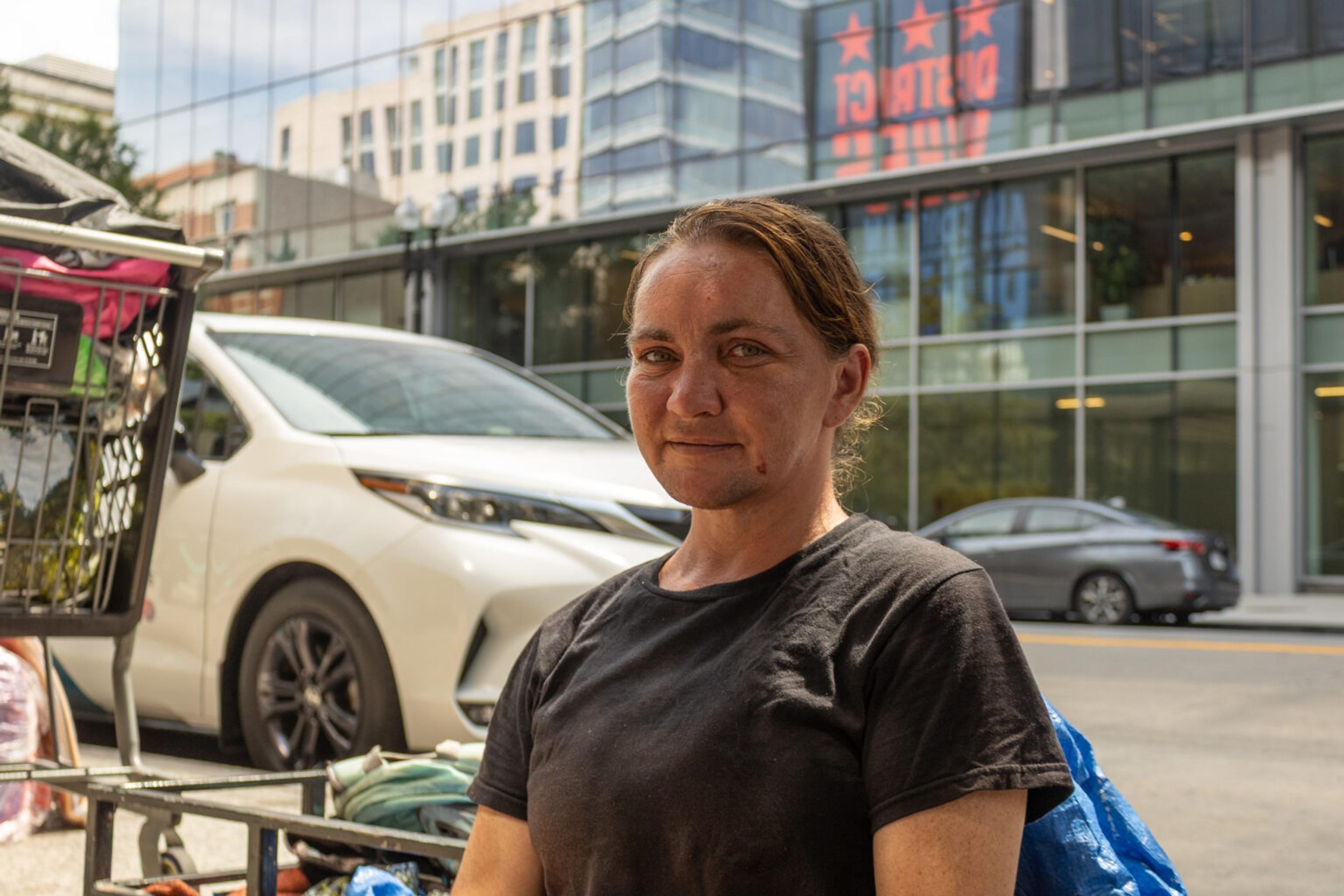

Photo by Madi Koesler
By Madi Koesler
- News

On the afternoon of 14 August 2025, DC police walked the streets surrounding the White House looking for encampments. Officers took notes of where people experiencing homelessness slept and sat, emails that Street Sense obtained via public records request show. After the team of at least three walked the streets of downtown DC, they created a list of 25 tents, tarps and benches.
At least 14 of those sites would be removed by local police in federally driven encampment clearings the next day, displacing over a dozen people. The week that followed—full of encampment clearings motivated by President Donald Trump’s hardline stance against visible homelessness—caused confusion and chaos among people experiencing homelessness in the District and changed the reality of living outside.
While it was immediately clear that the closures in August of last year resulted from federal pressure, additional emails from that time obtained by Street Sense shed light on the weeks-long federal influence on DC’s homelessness policy, and how that week’s actions continue to echo a year after the takeover officially ended.
As jurisdictions across the country pass anti-camping legislation, the White House continues to push for “beautification” and criminalizing sleeping outside through executive orders and funding decisions. In the District, long-standing, multi-tent encampments have been eradicated as single-person encampment clearings have skyrocketed.
As Deputy Mayor for Health and Human Services Wayne Turnage said during an oversight hearing earlier this year, DC has shifted from maintaining encampments to closing them, with the District on track to close twice as many encampments in 2026 as in 2025. The impact of the two-week crackdown on visible homelessness last summer lingers. And so do questions about what actually happened.
***
Federal interest in homelessness in D.C. began months before the takeover. On 28 March 2025, Trump signed an executive order creating the DC Safe and Beautiful Task Force to increase police presence in public areas and maximize immigration enforcement. The order specifically mentioned removing all homelessness on federal land, creating anxiety among outreach teams and encampment communities.
Emails obtained by Street Sense shed light on the taskforce’s early interest in the District’s response to homelessness.
In a thread beginning on 2 May 2025, Orville Greene, then the White House official in charge of the task force, who also served as the Homeland Security Council’s transnational threats director for narcotics and opioids, according to his emails, connected with a mix of local and federal agencies to establish the “Homelessness Working Group”.
“We look forward to helping you through any blockers to ensure the execution of President Trump’s Executive Order,” Greene ended his email.
On 7 May, Talor Wasden, née Allen, policy advisor for the National Security Council (NSC), responded. She listed the organizations that made up the group: the Federal Highway Administration, the US Department of Health and Human Services, the US Department of Housing and Urban Development (HUD), the DC Department of Transportation, the Executive Office of the Mayor, the National Park Service (NPS), and the Metropolitan Police Department (MPD).
Some of these agencies, including the NSC and MPD, would eventually collaborate on federally led encampment clearings in August 2025.
HUD Deputy Assistant Secretary Caitlyn McKenney replied to this thread with an attached proposal for an emergency shelter in DC for the group to discuss with the goal to “decrease unsheltered homelessness and increase public safety and access to public spaces.”
Street Sense has not obtained further communications from the working group’s discussions. But three months later, on 10 August, Trump posted photos of tents along I-66 on Truth Social. The next day, Trump declared “Liberation Day” during a press conference, officially invoking Section 740 of the DC Home Rule Act, allowing the president to take control of MPD during an emergency, and deploying the National Guard to the District.
Anxiety, chaos and poor interagency communication ensued over the following days as DC’s Office of the Deputy Mayor for Health and Human Services (DMHHS), which houses the city’s encampment team, cancelled scheduled encampment closures, turning instead to the tents photographed by Trump—setting a precedent of rapid-paced clearings with reduced notice and outreach.
Normally, the DMHHS encampment team partners with locally contracted outreach teams and the DC Department of Behavioral Services (DBH) to give encampment residents notice and offer shelter and storage for their belongings before clearings. While police are sometimes present at encampment closures, they are not led by law enforcement.
At the time of the federal takeover, DMHHS’ protocol required that this team give at least a week’s notice before scheduled engagements unless there were immediate health and safety concerns. All clearings also had to be justified by health and safety concerns until early 2025, when Turnage, who oversees DMHHS, said in an oversight hearing that increased immediate closures were “more consistent with the mayor’s goal that people don’t sleep outside.”
NPS has the authority to respond to homelessness on federal lands, like parks and monuments, but, unlike DMHHS, it is not required to provide prior notice or connect residents with outreach services.
DMHHS began preparing for the possibility of a federal surge on 7 August, internal emails show. In one email, in response to a concern from a community member, Turnage wrote, “If Trump declares an emergency and brings in the National Guard to supplant law enforcement, whether the encampment is on federal or District land will not matter. This will be a difficult three or four days.”
Emails from the evening of 13 August between Greene, who has an NSC email address, Turnage, Deputy Mayor for Public Safety and Justice Lindsay Appiah, former DC Police Chief Pamela Smith, Chief Inspector Donald Snider—who commands the Capital Area Regional Fugitive Task Force for the US Marshals Service (USMS)—and redacted parties from the US Department of Justice established Turnage as the District’s point of contact for encampment removals that night. Turnage asked federal officials to give his team advance notice so they could marshal “necessary social support services.” This request would largely be ignored.
On the morning of 14 August, the District led a closure at the grassy field beside the Peace Institute—now named after the president—which Trump had posted photos of days earlier. It displaced at least eight residents. Despite the heightened attention, the process generally followed DC’s encampment protocol, which requires that residents receive notice and be offered services; the normal groups of outreach workers, encampment team staff, biohazard engineers and behavioral health workers just moved on a tighter schedule due to the federal pressure.
Following the clearing, Turnage took questions from the press. He told reporters that the District did not have control of a list of encampments that federal forces wanted to close, but he had received notice that closures could begin that evening. “We don’t control the list. If we got it, we certainly will be happy to share it, but we don’t have a list right now,” Turnage said.
Internal emails obtained by Street Sense show that around the same time that Turnage fielded questions, MPD officers, then under federal control, were developing a list of encampments, all within a roughly 10-block radius of the White House. At least 14 sites on the list would be the target of MPD clearings that would break District protocol and send shockwaves of fear across the city in the following days, though outreach workers and residents confirmed that several of the other sites were impacted during the federal takeover.
The officers, whose names were redacted, sent their notes, at least some of which were in Comic Sans font, to Commander Jason Bagshaw to compile into a finalized encampment list at 1:31pm. One of the canvassing officers specified in a follow-up email to Bagshaw that “All sites provided were encampments of either tents or tarps cover park benches.”
While DMHHS and the D.C. Department of Human Services (DHS) maintain encampment lists and information on people sleeping outside for outreach purposes, neither Street Sense nor outreach workers are aware of police leading an effort to identify encampments.
The 25 sites were as follows:
The 25 sites were as follows:
“1. 1313 New York Ave NW east Side, Park area
- 1405 G ST NW Front of/ North Sidewalk
- 1300 H St NW south side of the Street Blue tent. on sidewalk.
- 901 G St NW Green Tent North side
- 501 5th St NW east side black tent against brick building.
- 436 11th St NW Doorway Harrington Hotel west side of the street.
- 900 blk 27th St NW east side orange tent under bridge
- 1000 blk 27th St NW (Ramp to Rock Creek PWY, From K st NW) East side green tent with a motorcycle next to it.
- 2300 Blk Pennsylvania Ave NW Green Tent in the Grass median. Just west of the Circle.
- 24th And K ST Opposite 2375 Penn Ave NW - Brown tent, north side.
- 2200 blk K St NW two green tents
- 1000 24th St NW West side sidewalk brown/Blue tent F/O 2401 Penn.
- 21st and E St NW - Blue Tarp in median on park bench
- NB E St Expressway, Exit to 27th St NW - West side of the road there is a tent along the jersey barrier
- NB Potomac River FWY just north of E ST (Northbound and Southbound sides) – large encampment
- Triangle on N/S of 1800 Pennsylvania Ave NW. - Large cart of homeless belongings
- Triangle S/S of 2000 Pennsylvania Ave NW - Blue tarp tent set up on bench
- K St and Washington Circle NW (EAST SIDE) - two tents
- Washington Circle NW (Inside circle on east side) - 1 Tent
- Washington Circle NW & K St NW (WEST SIDE) - 4 Tents
- Rock Creek PKWY NB, North of Virginia Ave NW just past the fenced in lot filled with jersey barriers to the north under the trees. - 1 tent
- N/B Potomac River Freeway, in the triangle on the left side on the Exit to Lt St NW - 2 tents
- 24th St NW and Pennsylvania Ave NW - on the north side of the intersection - 1 tent
- 21st and K St NW (SE Corner) – Blue tent
- 22nd and K St NW (SE Corner) – Gray tent”
Highlighted locations are confirmed to have been impacted by encampment clearings on 15 August 2025.
MPD’s then-Executive Assistant Chief of Specialized Operations Jeffery Carroll, now the interim chief, sent the finalized list in a separate chain between MPD officers, Turnage, Appiah, Smith, DC DHS Director Rachel Pierre, and encampment team members at 3:57pm, asking that it not be shared outside the group.
That afternoon, DMHHS notices were placed at several of the tents near Washington Circle. The area was scheduled to be cleared at the end of August; the notices moved up the clearing to that upcoming Monday.
Closure notices became a point of contention between Washington Circle encampment resident Meghann Abraham and federal forces when officers from the Federal Bureau of Investigation, Secret Service, and Homeland Security arrived around 9pm later that night to clear the site. Abraham responded by showing them the notice that she had received from the District, insisting that she had until Monday to relocate. The large group of federal agents took photos of the notice and surrounding tents, then left.
As this standoff ensued, then-US Attorney General Pamela Bondi issued the now-nicknamed “Bondi Order” to DC Mayor Muriel Bowser that attempted to seize operational control of MPD. This essentially implemented Drug Enforcement Agency Administrator Terrence Cole as the “Emergency Police Commissioner”, or the police chief. It also directed officers to enforce laws and regulations around unlawful occupancy of public spaces “to the maximum extent permissible by law.”
Federal forces regrouped in the circle around 9:30pm and did not leave the area until around midnight, though they did not attempt to clear the encampment. Outreach workers and local government officials, under the impression that the District had prevailed, reassured residents they would have until Monday to pack, relocate, and move into shelter if they wanted to.
The next morning, everything shifted when Andy Wassenich, director of policy for Miriam’s Kitchen, received a call around 10:30am from a friend who worked in a building overlooking the District’s Downtown Day Services Center, where people experiencing homelessness often meet. An influx of MPD officers had just arrived outside the day center, which had also been included on MPD’s list of sites.
Immediately, Wassenich messaged a Signal group chat with other homelessness outreach providers and mutual aid partners. As outreach teams scrambled to mobilize to other sites on the list, MPD officers and multiple Department of Public Works (DPW) crews arrived nine blocks away at Washington Circle around 10:40am. Without any advance notice, DPW workers began filling trash trucks with the tents and belongings of residents, many of whom were not present, as at least 15 officers stood watch.
While Abraham was on the phone with her dad, MPD officers approached her, telling her, “We’re clearing all this up today.” Her boyfriend, with whom she shared her tent, was at work, and her neighbors were nowhere to be found. As trash trucks surrounded the circle and DPW workers began to drag tents full of belongings into the street to dispose of them, Abraham rushed to decide what she would be able to carry away with her just as outreach workers arrived at the scene.
MPD and DPW crews then moved west from Washington Circle to continue to clear tents near Godey Lime Kiln and Rock Creek Parkway, sites also on the MPD encampments list, as outreach workers raced after them on foot to attempt to reach residents before police.
As MPD cars flashing their lights escorted trash trucks full of tents and furniture out of Washington Circle, it appeared that the District’s encampment team had no idea. In an email sent by Turnage at 11:01am to various members of the team and other local agencies, he warned that MPD might close Washington Circle before the District’s scheduled engagement three days later, despite his recommendation to them to wait.
“It was not clear to me from the conversation whether my advice will be heeded,” he wrote. “We are waiting to hear from federal officials and MPD regarding their plans for tonight and the weekend. By any metric, last night did not go well and they will regroup today.”
At this point, the Washington Circle encampment was already gone.
***
Meanwhile, the balance of power was shifting behind the scenes. Just after 5pm that afternoon, outside the E. Barrett Prettyman United States Courthouse, Bowser and DC Attorney General Brian Schwalb addressed the media, revealing that Judge Ana Reyes had restored Smith’s position as MPD chief.
“We have made it very clear that we have laws in our city,” Schwalb told the crowd.
MPD declined to comment on questions related to the Bondi order and any directives regarding encampments issued by Cole between 14-15 August 2025. To the knowledge of outreach workers and Street Sense, the only MPD-led clearings took place while Cole was in control of MPD. The DC Attorney General also did not respond to a request for comment.
While the ruling reestablished local control of MPD, it did not stop federal influence, and the fight between local agencies and federal forces to control unsheltered homelessness in the District was just beginning.
In the week after the Washington Circle clearing, DMHHS, DHS and DBH grappled with how to respond to federal requests for encampment clearings, internal emails show.
Late into the night on 16 August, Greene asked Turnage for his “urgent assistance” assigning a point of contact to assist “relocating the homeless encountered by law enforcement [in] the District tonight and tomorrow night.”
Turnage responded the next morning, appearing confused, asking about the federal clearings, and noting that he was informed that the “encampment phase of the operation [was] complete.” He again urged Greene to inform the District if encampment sweeps continued so that it could direct its outreach teams for assistance.
Multiple internal interagency meetings wrestled with how to respond to one-off encampment requests from MPD and the White House, the impacts of federal clearings, and how to adapt. An agenda Turnage sent to his administrative assistant on 20 August for one of these meetings includes items such as: “Report on Latest Census For Homeless Encampments,” “Resources Required To Execute A More Expedited Encampment Clearing Process, Post Federal Surge” and “Changes Needed To Implement A More Appropriately Aggressive FD – 12 Process.”
“I will use the information from this meeting to develop a communication to the [city administrator] with specific recommendations to expedite encampment closures following the surge, and to have a more efficacious FD-12 process,” Turnage added.
In the following days, emails from Turnage suggest a so-called “tour of duty” began with District staff on 24-hour standby for federal agencies to call about homelessness. A 20 August email from a DMHHS staff member notes that Bowser specifically asked for behavioral health and encampment teams “to be ready for deployment once a concern is flagged.”
Emails from 21 August confirm at least one federal official, Greene, was still directly involved at this point. Turnage wrote to his team at 7:28pm, “But Orville [Greene] is saying ‘hold your people until I speak with [Jennifer Reed, director at Office of Budget and Performance Management]’” regarding sending home staff on call for evening encampment engagements.
This email is the last documentation that Street Sense obtained on federal involvement with closures. But outreach workers say that federal pressure remains, continuing to cause displacement and disruption.
When asked specifically about collaboration with the White House, MPD, federal law enforcement, and the NSC on encampment clearings between 11 August and 13 September 2025, a DMHHS spokesperson stated, “There were no special collaborations initiated to report on behalf of DMHHS” and deferred to MPD and federal agencies “to speak to their process on encampment engagements.”
MPD, for its part, deferred to DMHHS and stated, “The MPD’s role in encampment removals is limited to maintaining peace during engagement events related to encampment protocols.” The White House did not respond to requests for comment.
On 19 August, then-Press Secretary Karoline Leavitt said in a briefing that 48 encampments were cleared by “multi-agency teams [and] MPD Patrol units.” Street Sense has never been able to independently confirm this number, and the White House has not provided lists of locations or dates despite multiple requests. In addition to the 25 sites on the list, many of which were cleared, there were three more federally mandated clearings and seven District-led clearings between 18 August and 1 September, according to DMHHS. Combined with the closures near the Peace Institute and clearings mentioned in internal emails, this could include up to 40 sites.
Additionally, since the announcement of the Safe and Beautiful Task Force, NPS has cleared 169 encampments on federal land, the agency wrote in a statement on 28 August 2026. NPS declined to provide lists of sites impacted or dates to confirm if these sites were included in the number that Leavitt mentioned and has not responded to Street Sense’s public records requests for the information.
***
Despite claims by Trump at a rally in August of this year in South Carolina that “The homeless are no longer there [in DC] in the tents that were all over the place,” hundreds of people are still living outside in the District and have only been forced to become more mobile.
Following the clearings, Abraham and her boyfriend moved to a secluded part of the woods roughly two hours by bus from Washington Circle. But after their tent burned down last winter, they have found themselves sleeping outside MLK Library, where they met.
Since moving back to downtown, Abraham has been able to reconnect with caseworkers but feels let down by the outreach system. She has been waiting for a housing voucher for about two years and transitional housing for four months. “They’re just making you go around in circles and there is no way out of it,” she said.
Even with new enforcement of a sleeping ban at the library, they plan to stay in the area because they count on the groups that come by with food, clothes and toiletries. Abraham also relies on internet access and library computers to complete her online college coursework at the University of Maryland Global Campus, where she is pursuing her bachelor’s in Homeland Security, supported by Pell Grants and student loans.
In the year since the clearing, Abraham has only seen one of her old neighbors once while eating in the Miriam’s Kitchen dining room.
She had him write down his number on a piece of paper because she shares a phone with her boyfriend, but on the walk home, it started to rain. When she got back to her encampment and pulled out the number, the rain had smudged the writing. She hasn’t seen any of her old neighbors since.
“I don’t know where they went,” she said. “It’s kind of stressful to have someone in your life for a year and then have no way to contact them. That’s what all this displacement is doing.”
Outreach teams echo this sentiment. Since several of the clearings last year did not work with District teams to provide outreach, caseworkers have lost contact with dozens of clients, cutting off crucial access to services.
When residents move between the three Street Outreach Network’s provider zones, there is no communication between the District-contracted service providers. Providers can see outreach history in a shared database if residents reconnect. But this is not guaranteed.
Amid a voucher drought that continues to delay residents’ transition off the streets, outreach workers are fearful of the continued communications disruptions and their lasting impact on people living in encampments. Outreach workers emphasized that without proper communication, repeated clearings can create unnecessary trauma.
“Perhaps society has always felt this way, but to have it said so blankly and then to have the action be so clear, it is felt deeply by our guests,” said Claire Wilson, executive director of Georgetown Ministries. “This past year, we’ve seen a lot more trauma, a lot more complexity in terms of behaviors. A lot of people are feeling very, very defeated.”
According to outreach workers and government employees, the encampments team is trying to adhere to normal protocol when possible, but federal pressure continues to make this difficult.
Prior to the federal takeover, outreach workers say that there was more communication from DMHHS ahead of encampment closures. But now, on multiple occasions, outreach workers say that they are not properly notified of scheduled engagements by the encampment team. Outreach workers have found out about scheduled engagements first from clients, after they received stickers marking their belongings for cleanup. DMHHS has also repeatedly cancelled interagency monthly meetings between DHS outreach partners and the encampments team, according to one of the outreach partners.
The District has cleared more encampments so far this year than in 2024 or 2025. The monthly average for clearings for those years sat between eight to nine per month, but according to data from DMHHS, the monthly average so far this year is closer to 17 clearings.
Clearings this year also look different. Outreach workers and legal advocates have noticed increases in clearings of single-person, mobile set-ups that wouldn’t have drawn attention in the past. This is especially true of Ward 2, which includes most of downtown, where there’s a high number of federal forces. If tents do pop up, they are almost immediately tagged for removal, outreach workers said. There are no longer visible, long-standing, multi-tent encampments in DC as a result of these efforts, but people remain outside.
DMHHS denies that any of its policies have changed. A spokesperson repeated many times in a statement to Street Sense that “The posture of the DMHHS Encampment Response Team has remained consistent as it relates to supporting service engagements and connection efforts for vulnerable residents residing in encampments, while continuing to address all health and safety concerns or intrusions connected to encampments on public space.”
Outreach workers, advocates and people living outside continue to argue against displacement. Instead, they are urging the federal and local government to shift focus and funding from increasing clearings to housing vouchers and wrap-around services that focus more on residents’ wellbeing than erasing visible homelessness.
“If you really don’t want to look at us, you really need to provide services—give us actual options that are viable,” Abraham said. “A lot of us are down and out of it. We need a hand up. Give us the hand up.”