Apocalypse in the age of Bridgerton


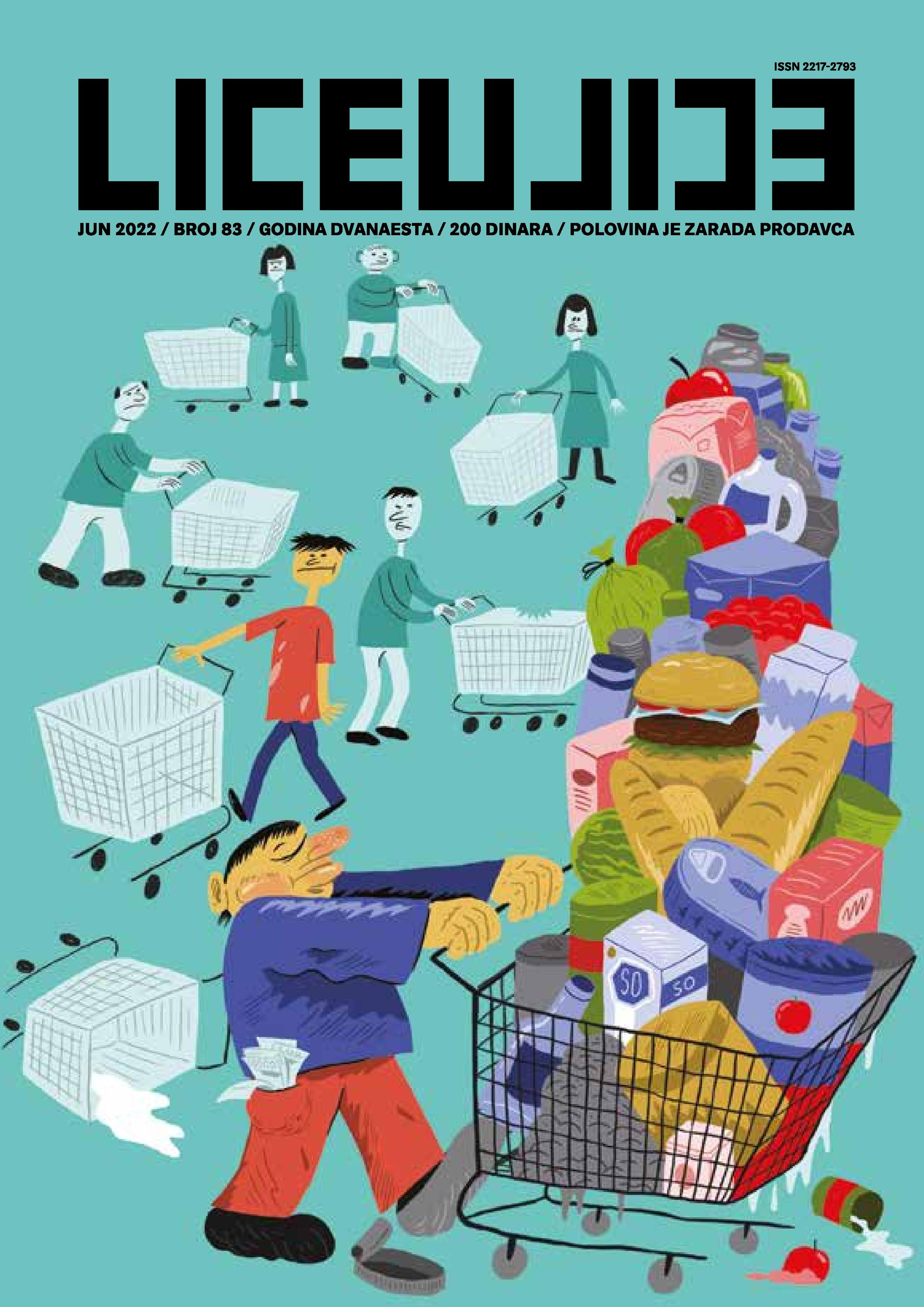
Illustration by Zoran Svilar
By Dunja Karanovic
Translated from Serbian by Rade Zivanovic
- News

Netflix announces which romance will be the focus of the fifth season of Bridgerton.
The US spent $12.7 billion on the war in Iran in just six days.
A lemur enjoys the morning sun.
In Lebanon, 1,094 people have been killed since the start of the war with Israel.
Little monkey Punch has a new friend and is gradually letting go of his orange plush toy.
In Gaza, 1,722 medical workers have been killed.
In written form, this sequence of information makes little sense, but when we follow the news through social media, the principles of logic and storytelling are subordinated to the principles of algorithmic curation. Fragmented information about what is happening in the world alternates with entertainment content in a whirlwind of moving images whose main purpose is to hold our attention for as long as possible.
On social media 10 years ago, one of the main principles guiding algorithms was the potential to provoke anger or division. Such algorithms helped to fuel a presidential campaign that was unexpected at the time, but also the perception that social dialogue was impossible because the divide between red and blue, right and left, was simply too great to bridge. Polarising, shocking and controversial political statements were then the most powerful way to attract and retain attention.
That rule still applies today, except that political topics are no longer favoured by algorithms. For the stream of information we see when we open our feeds to resemble the one at the beginning of this article, users have to make an effort: an extra step to enable political content, another to remove the “sensitive content” label, and further steps to search for, save, share and like information.
The whirlwind prefers entertainment because, over the past decade or so, it has learned that users cannot cope with the flood of negative information. The world is on fire, we all know that, but dwelling on the flames creates a bad vibe.
Talking about the genocide in Gaza, for example, creates a bad vibe, so journalists who want to inform the public about it have to employ a whole range of techniques to get around the algorithm. These range from various euphemisms and diminutives used to disguise the words “Gaza”, “genocide” and “Israel”, and the watermelon symbol meant to encapsulate decades of dehumanisation and atrocities, to TikTok trends and photographs from the Oscars with news of bombings superimposed on them.
For now, these methods are working, at least to the extent that news occasionally breaks through to audiences. But the question remains as to how deeply it registers in our consciousness when a single swipe of the thumb can replace it with something more cheerful.
The history of media shows us just how much influence visual content has on public perception, but also how important the context is in which we encounter that content. Among the many developments that marked the long nineteenth century, the inventions of several Frenchmen and one Englishwoman are particularly significant to the era that we live in today.
Throughout the nineteenth century, scientists and artists developed ways to capture first a single moment, and then a sequence of moments that together create movement, using paper, zinc and copper plates, and celluloid. They could hardly have imagined the extent to which photography and film would transform society. Today, these media, together with the many technological advances brought about by the digital age, are inseparable from our understanding of the world and from the political, social, and technological forces that shape that understanding.
At a time when one of the most destructive political forces in history was expanding its influence in Germany, the films of director Leni Riefenstahl served as tools of indoctrination, incitement to hatred, and ideological preparation for war. One of those films, Triumph of the Will (1935), had the opposite effect on American director George Stevens, motivating him to join the fight against the Nazi regime.
Stevens’s documentary footage, filmed during the liberation of the Dachau concentration camp, was used as evidence at the Nuremberg trials. Few written documents contributed as much to public understanding, condemnation and remembrance of the crimes of the Second World War as those black-and-white sequences of mass graves and starving, tortured prisoners.
After the war, Stevens won the Academy Award for Best Director in 1952, while Leni Riefenstahl began a decades-long battle to restore her reputation after being identified as a supporter of the Nazi regime during the Nuremberg trials. One of the central claims that Riefenstahl maintained until her death at the age of 101 was that she had been creating art, not political propaganda.
It is worth noting that, with the exception of Triumph of the Will, most of her works did not promote Nazi ideology quite so explicitly. The first major and expensive film she made on commission from Goebbels and Hitler after 1935 was Olympia, a documentary about the 1936 Summer Olympics in Berlin.
Goebbels’s Ministry of Public Enlightenment and Propaganda understood the power of moving images to shape public opinion, not only directly, through technologically advanced displays of the German military’s strength, but also indirectly, through entertainment and achievements of undeniable artistic and aesthetic merit.
Moving images move us, capture our attention, stir emotions, and, when necessary, pacify us. In an age saturated with moving images, we probably know far more than Goebbels did about the relationship between film and the physiological changes it produces in the brain, including its effects on levels of important neurotransmitters such as dopamine and serotonin, its potential to cause addiction, and its various effects on attention.
What makes today so different from 80 to 100 years ago is the sheer volume of moving images that we encounter and the context in which we consume them, or, to use contemporary terminology, content. Images of wartime destruction alternate with video game clips, followed by footage of climate disasters, funny cats, AI-generated brainrot animations, and shocking statements from far-right extremists leading some of the world’s most powerful countries. All of this unfolds in no more than 90 seconds, of which most people watch only the first seven.
Goebbels might have quickly mastered the dubious world of algorithms and artificial intelligence, but the question is how much influence Leni Riefenstahl and George Stevens would have had on audiences if they had been limited to seven seconds.
Triumph of the Will horrified Stevens, but it also inspired him to go to war. Many Germans felt pride while watching that film, just as many felt shame after seeing Stevens’s footage from 1945. All these emotions – pride, enthusiasm, anger and shame – require time and attention: two things that today have almost immeasurable market value, yet are becoming increasingly scarce in our lives. What remains after we finish scrolling through a sea of moving images, from the Japanese monkey Punch and his IKEA plush toy to the horrifying scenes from Gaza and Iran, is exhaustion and hopelessness: two emotions unlikely to motivate us to act.
Many people cope with the constant anxiety that seems to come as part of living in the 2020s by escaping into fictional, or at least seemingly orderly, worlds. We can see this in the fact that the fourth season of Netflix’s Bridgerton accumulated more than three billion minutes of viewing time in its first week, while the Canadian series Heated Rivalry attracted around 10 million viewers per episode in the US alone. The Winter Olympics in Italy generated more than 16 billion minutes of viewing time on streaming services, while Bad Bunny’s Super Bowl performance reached a record 4.157 billion views in just 24 hours.
Among the 50 most searched terms on Google in the first three months of this year, “Netflix” ranked 25th, ahead of “Iran” and “Trump”, the only political terms on the Top 50 list. Escapism has always been part of human society because avoidance is a defence mechanism with its own psychological purpose and value. But when measured in billions of minutes, views and clicks, it becomes frightening.
The German philosopher Theodor Adorno famously declared that writing poetry after Auschwitz was barbaric, and this sentiment could certainly be applied to watching Bridgerton at a time when the principles of international humanitarian law are being repeatedly violated. In today’s world, however, remaining aware of suffering and injustice requires us to inhabit the algorithmic whirlwind constantly, without feeling that there is anything we can do about it.
What fictional worlds and spectacles such as the Super Bowl, the Oscars, or the imagined Regency-era world created by Shonda Rhimes offer is a sense of control and security, clear rules, and relatively predictable storylines with just enough uncertainty to hold our attention without causing distress. In the real world, by contrast, catastrophes follow one another, traumatising and retraumatising us, while the only action available to us seems to be scrolling onward.
In other words, it would be unfair to call binge-watching barbaric, because we live in a world that is in many ways more complex than Adorno’s. But neither should we surrender to the whirlwind. Even Bridgerton and the Super Bowl can create opportunities for political dialogue. We see this, for example, in Irish Bridgerton star Nicola Coughlan, who uses her fame to speak out about Palestine, or Bad Bunny, who used his 4.157 billion views to draw attention to racism and colonial violence in the US. The same goes for the international stars who have called for a ceasefire at the Oscars.
Moderate and deliberate news consumption is the antidote to doomscrolling, and rest and self-care are not offenses as long as they do not distract us from the things that we can still control: what we read and watch, where we spend our money, who we vote for, and when and with whom we take to the streets.