“Gateway to Hell”: inside the “worst residential building” in Germany
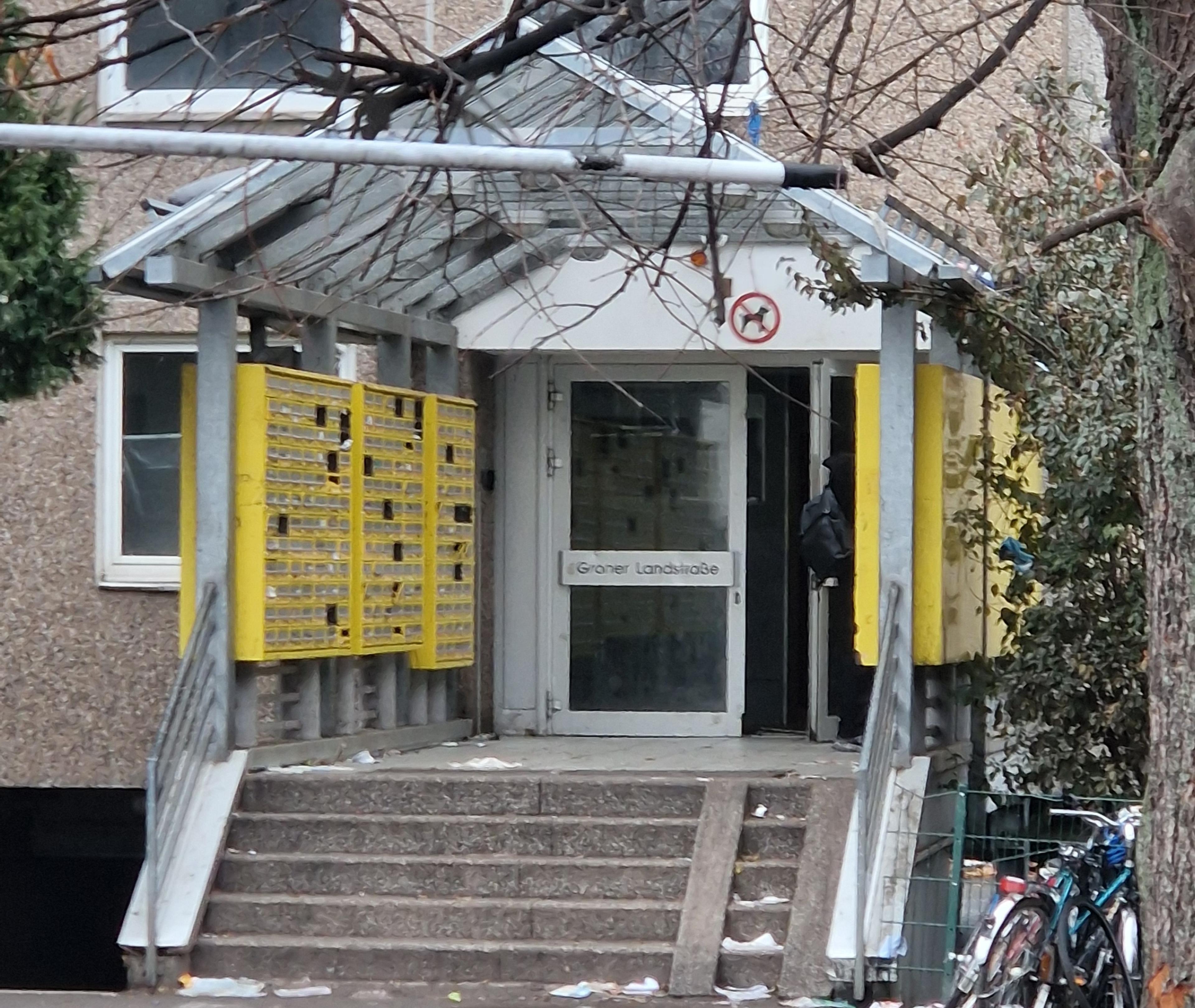

Photo by Ute Kahle
By Ute Kahle
- Lived experience


The letterboxes speak volumes. The residential complex at 9, 9a and 9b Groner Landstraße in Göttingen was built in 1979 and, with its 11 floors, 431 flats and 150 parking spaces, is one of the largest residential complexes in the city.
A glance at the building reveals that the ageing complex has many shortcomings. Flats have been damaged by fire; windows are broken, missing, or temporarily boarded up. There is rubbish everywhere. But the main problem for the current tenants is that the lift has been out of order for months, and, more importantly, the heating system is broken.
According to the complex manager, its repair is currently not possible. He said that he cannot find a specialist company to get the system working again. Over the years, the once popular residential complex has increasingly been transformed into a depreciating asset.
When Omega AG became insolvent, Gänseliesel Wohn GmbH and Winteks GmbH, which together own the majority of the flats, were caught up in the crossfire. The fact that the communications company commissioned by the insolvency administrator returned the flats to the owners designating them as “worthless” and therefore not realisable within the framework of the insolvency proceedings further exacerbated the situation.
In November 2025, the municipality of Göttingen, in partnership with the DMB Tenants’ Association Göttingen (a registered society), invited all the tenants of 9, 9a and 9b Groner Landstraße to an information event and provided a team of volunteer translators. The turnout was enormous. The situation, especially the state of emergency regarding the heating, was discussed, and free support in finding a solution was promised. All those involved suggested taking joint action against the landlords. This was the only way of putting pressure on the owners and addressing the issues.
The Tenants’ Association provided sample letters to landlords and the municipal authorities, which were adapted to the tenants’ needs. They contained an individual list of defects (e.g. broken heating, draughty windows, broken down lifts, pest infestations and flats that cannot be locked) and requested the landlord to rectify these immediately. They also explained that due to the reduction in the property’s value, a rent reduction of 50% would be applied in most cases and an increase to 100% could not be ruled out in the event of a prolonged heating failure.
Thirty tenants accepted the proposed way forward on the spot, with others following suit after the meeting. The Tenants’ Association advisers also reminded the tenants of their obligation to document the damage and the additional costs that they incurred. Some have been provided with radiator heaters by the complex management, while others are making do with fan heaters or warming themselves up briefly with the warm air from the oven. These are costly and potentially dangerous measures that could lead to some unpleasant surprises when the next energy bills arrive. The Tenants’ Association therefore advised the tenants to record the additional consumption using separate submeters and heating logs, which they must purchase themselves as they also have no access to their meter readings, and to reduce their rent by the amount of the heating cost prepayment.
Tenant Calina Farcas-Moldovan complained: “I’ve always paid my rent on time, but the owners are letting me and my four children freeze here. I’m afraid it will get even worse in winter.” In November, her two daughters were already unable to attend nursery for 14 days because they had an infection that would not go away. The mould on the walls of their flat raises concerns that the family is exposed to further health risks here. She pays over €660 in rent and utilities, which, at her request, is transferred directly from the job centre to the landlord. She has no rent arrears. She hasn’t received an electric radiator yet.
She has now gone public and, with her lawyers Sven Adam and Nils Spörkel, is trying to bring the matter before the Göttingen District and Administrative Court using a fast-track procedure. She wants the city authorities to declare her flat uninhabitable. They could then accommodate her and her four children and charge the resulting costs to the landlord. Until then, she has no choice but to wait for the court decision, give her children hope, and try to find another flat. She says that she is very grateful for all the support. She hopes that this will allow her to obtain justice and decent living conditions.
Stefan W. (not his real name) also lives on Groner Landstraße in the “Gateway to Hell”. He is one of the oldest tenants and has lived there for decades. “The fact that everything is in such a state of disrepair is the fault of the property managers. There used to be a lot of action here; there was a building manager and rules,” he said. He no longer knows who his point of contact or the current owner of his flat is. “I hope the city gets its act together soon; this can’t go on,” he said. Until then, he is hoping for a mild winter.
Gicu Secelean, who has never been in rent arrears, has been a tenant for years and cannot find a way out. “I suffer from severe asthma and shortness of breath as there is no heating, and the mould in my micro flat is not good for my health,” he said. “But with this address, you won’t find another flat in Göttingen. This is the end; after that, you’re out on the street." Nevertheless, as an Asphalt vendor, he stands at his pitch in Geismar almost every day and has not given up hope yet of decent housing.
In the invitation to the tenants’ meeting, Head of Social Services Anja Krause wrote: “Tenants must assert their interests against landlords themselves and, for example, withhold rent where there is a failure to carry out essential repairs. The municipality is not a party to the contract and therefore cannot take this on, but it supports the tenants in doing so.” The tenants are now requesting this support.
Ioan, who rents a flat for himself and his wife (for which he pays €530 in basic rent for 19 square metres), summed up the problem: “Rubbish is a big problem here, and the tenants are not entirely blameless. But if the landlords don’t pay the municipality, then there are no dustbins, no refuse collections, and everything just ends up anywhere. But we all worked together to clear the courtyard of rubbish again. A lot of people pitched in, but many also just laughed at us, which was a shame.”
Dominik Fricke, managing director of Coeles property management, describes at least half of the tenants as “unfit” to reside there and sees this as the problem. Furthermore, the provisional insolvency administrator of the majority owner has transferred too little money to the housing association, and tenants receiving benefits are in arrears with their payments by a six-figure sum.
Ms. Schrader from the Department of Culture, Social Affairs and Health directly refuted this accusation: “Currently, 129 households who receive benefits have been reviewed, and in 98 cases, the rent is being paid directly and on time by the job centre to the landlord; 31 cases are still under review.” She added that she was unaware of any rent arrears in those cases.
Following the tenants’ meeting, the municipality noted that loans for rent arrears were applied for once in 2024 and seven times in 2025. Therefore, it sees no reason why the landlords should not have the heating system repaired, especially since payments to the municipality – property taxes and refuse collection charges – have already been deferred in favour of addressing the heating system.
Legally, however, the municipality’s hands are tied. “We have a system here where landlords of precarious residential properties have charged the highest rent for years,” said Mayor Petra Broistedt (Social Democratic Party). “The fact that the residents now have no heating is unacceptable.” She appealed to the legislature to find a solution for such cases.
The fact that the landlords have blocked the tenants’ parking spaces and closed them off with heavy barriers is causing further anger. Emergency services currently cannot access the front of Groner Landstraße due to roadworks, and the rear entrances are blocked by vehicle barriers. Tenant applications to the municipality for resident parking permits have been rejected. There is currently a shortage of parking places, and many residents who rely on a car for their commute have already received parking tickets. Allegedly, one or two parking tickets are issued per car per day.
At the time of going to press, the heating system had not been repaired, and it was still unclear how the tenants’ urgent applications would be resolved. However, the work taking place at the front of the building is for roadworks and not, as the tenants feared, for shutting off the water. This was threatened in the summer and is the tenants’ greatest fear.